






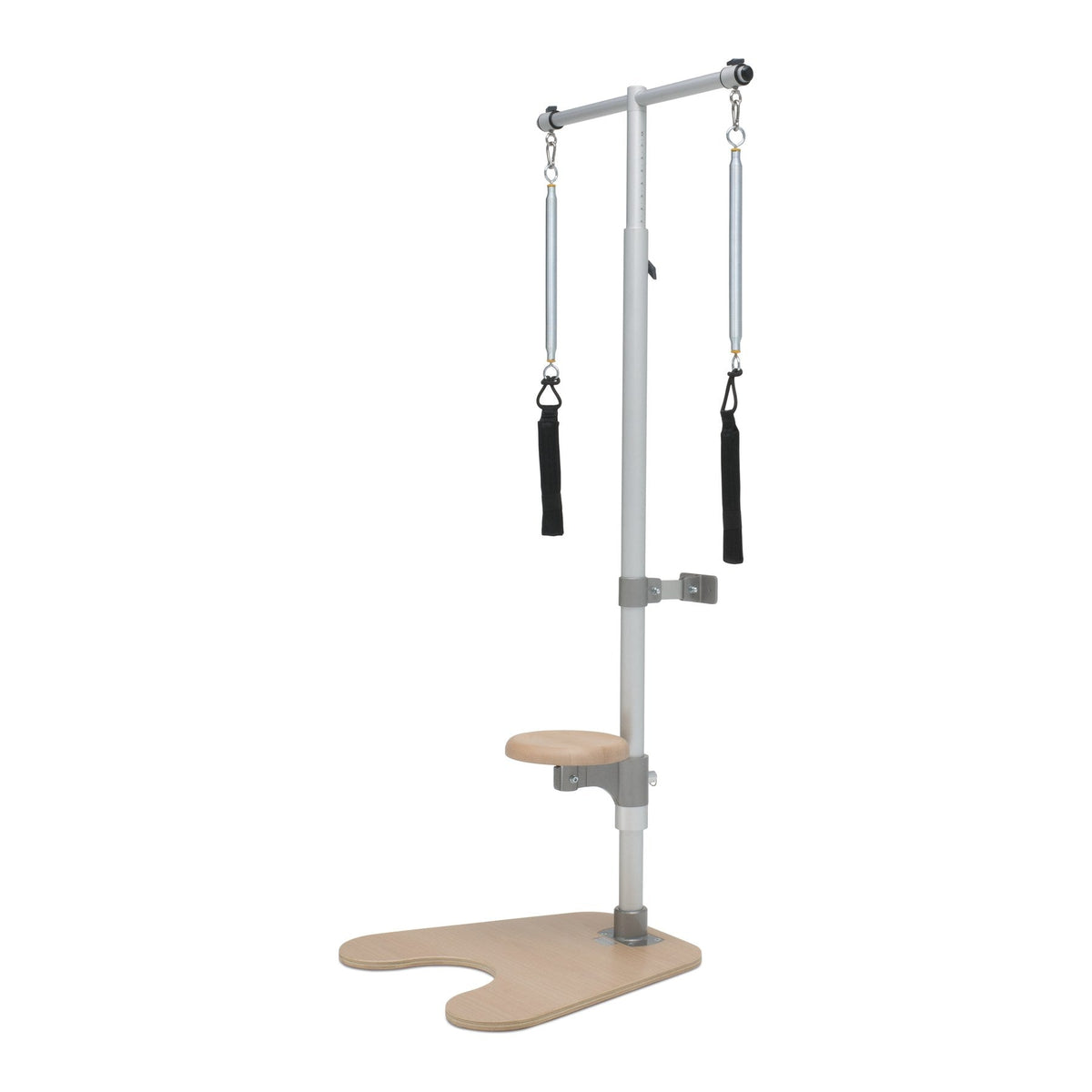
BASI Systems Ped A Pull
A freestanding spring apparatus for standing, seated and kneeling work. This is the version with the stool, which is the one most studios want, because the seat expands what can be programmed and rotates out of the way when it is not needed.
Spring settings adjust in height and width, so the line of pull is set to the exercise and the client rather than accepted as given. The base is shaped to keep the apparatus stable under loaded standing work, which is the movement a wall-mounted tower handles least well.
It occupies 25.6 in by 24 in of floor and weighs 31 lb with the stool. Two yellow springs and two neoprene handles are supplied.
What's Included:
- Ped A Pull frame, freestanding
- Wooden stool with adjustable, rotating seat
- 2 yellow springs
- 2 neoprene handles
- Manufacturer documentation
Specifications
- Width: 25.6 in (65 cm)
- Length: 24 in (61 cm)
- Height range: 61.8 to 109 in (157 to 277 cm)
- Stool seat diameter: 9.8 in (25 cm)
- Weight with stool: 31 lb (14 kg)
- Shipping weight: 40 lb (18 kg)
- Design: Freestanding, no wall fixing
- Frame material: Solid beech hardwood
- Spring positions: Adjustable in height and width
- Springs: 2 yellow
- Handles: 2 neoprene
- Stool: Included, height adjustable, rotates out of use
Lead time: 2 to 3 weeks.
Features
Freestanding, so the client can move around it
No wall fixing. That matters because the exercises this apparatus is bought for involve walking, turning and standing away from a fixed anchor, which a wall unit cannot support.

Spring height and width both adjust
Line of pull is set in two axes, so the same apparatus suits a tall standing exercise and a low seated one without compromise.

Stool included and rotating
The seat height adjusts and the whole stool swings clear when the exercise is standing. Seat diameter is 9.8 in.

Stable base under load
The base is shaped rather than square, which is what keeps a 31 lb apparatus planted when a client pulls against it from standing.

Light enough to reposition
31 lb with the stool. One person can move it between corners of a studio, which is not true of anything else in the spring range.

Installation
It arrives part-built
BASI crates its apparatus partly assembled. The frame comes as a unit and you fit the components that ship loose, typically the footbar, ropes, pulleys, spring holders and any tower or trapeze structure supplied with your configuration. Standard hand tools cover it and the fixings are in the box.
Two people, and time
Budget two to four hours for the larger frames and one to three for a plain reformer, with two people throughout. Weight rather than complexity is the reason. These frames run from roughly 150 lb to 330 lb and none of them should be carried alone.
Measure the route, not just the room
Freight arrives kerbside. Before delivery day, check the doorway widths, any turn at the top of a stairwell, and the ceiling height against the tower or trapeze figure in the specification table. Reversing a delivery costs far more than a tape measure.
Bed the machine in before you load it
Once assembled, run the carriage end to end several times to seat the wheels, confirm both ropes are the same length, and check that the footbar and spring holders lock positively in every position before working at full spring load.
Resources
- BASI Systems Ped A Pull instruction manual (PDF). Published by BASI Systems and re-hosted here so the link keeps working.
- BASI Systems care and maintenance guide (PDF). Cleaning, inspection and the spring replacement schedule the warranty depends on.
Warranty, Shipping and Returns
The published terms from BASI Systems are tiered. Ten years on main wooden frames and structural wood components. Two years on steel and aluminium profiles and components, on F2 systems, on springs and on plastic components and fasteners. One year on elastomer-coated parts, a list that includes the footbar, hand bar, pedals, stoppers, handles and wheels. Ninety days on the Pilates mat, on upholstered parts and on all fabric accessories. Cover runs from the invoice date, sits with the original purchaser and is not transferable.
One clause is a maintenance requirement rather than an exclusion: springs on spring-loaded apparatus are to be replaced every two years or after 3,000 hours of use, whichever comes first.
We do not charge for shipping within the United States. Anything crated goes freight, the carrier calls to book the window, and the handover is at the kerb, so line up help and measure your access route before the day. Parcel items typically arrive 7 to 10 business days after dispatch.
Look at every carton before you sign the Proof of Delivery. Damage and missing boxes have to be recorded on that document at delivery, and claimed within five business days, for BASI to accept liability.
You have 30 days from delivery to send unused equipment back in its original packaging. There is no restocking fee, refunds are processed within 7 business days of the return reaching us, and cancelling costs nothing until the apparatus leaves the factory.
About BASI Systems
The BASI Systems range comes out of BASI Pilates, the education organisation founded by Rael Isacowitz, and the equipment is engineered against the repertoire it is used to teach. The clearest example is the F2 System. Nearly every apparatus in the catalogue leaves the factory with prepared ports for it, so a studio can add spring work to a barrel, a chair or a spine corrector years after buying it.
Construction is consistent across the line: beech hardwood frames, aircraft-grade aluminium tracks and hardware, orthopaedic cushioning and antibacterial vinyl on every padded surface. BASI holds US patent 10,393,163 B2 on its spring positioning system, and an A Design Award for the Wunda Chair.
Choose options
The apparatus for standing spring work
Frequently Asked Questions
Quick answers on sizing, delivery and care. Anything else, write to us and a real person will reply.
Each order is packed and handed to the carrier as quickly as we can, and delivery times for your address are set out in our Shipping Policy. A tracking link is emailed to you as soon as your parcel is on its way.
Yes. Unworn items with their tags attached can come back within 30 days of delivery. Message us and we will walk you through it.